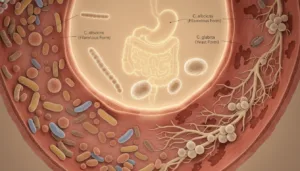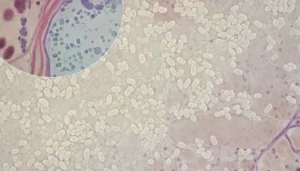
N-Acetylcysteine (NAC), a supplement derived from the amino acid L-cysteine, is gaining recognition not just for its antioxidant capabilities but also for its potent anti-biofilm properties, particularly against Candida species. This detailed exploration focuses on how NAC disrupts Candida biofilms, enhancing the effectiveness of treatments and providing a new avenue for addressing persistent infections.
Understanding Candida and Biofilms
Candida is a genus of yeast that can become pathogenic in certain conditions, particularly when it forms biofilms (1). Biofilms are complex communities of microorganisms that adhere to surfaces and are enveloped in a protective matrix. This matrix shields Candida from antifungal agents, making infections difficult to treat and often leading to recurrent symptoms.
What Are Biofilms?
Biofilms represent a significant challenge in medical microbiology. They enhance the resistance of organisms like Candida to conventional treatments because they act as a physical barrier, reducing the penetration of antifungal drugs (2). Moreover, biofilms can adhere to both inert and living tissues, including medical implants and mucosal surfaces.
The Biofilm Life Cycle
The life cycle of a Candida biofilm starts with adhesion to a surface, followed by colonization and maturation, where the biofilm grows and develops its complex structure. Finally, dispersion occurs, where cells break off to form new biofilms, spreading the infection.
NAC’s Mechanism Against Biofilms
NAC disrupts biofilms by breaking down the matrix components, primarily the extracellular polysaccharide matrix (3). This disruption exposes the Candida cells within, making them more susceptible to antifungal treatments.
Studies have demonstrated that NAC can significantly reduce the formation of Candida biofilms on both abiotic and biotic surfaces. For example, NAC has been shown to prevent Candida adhesion to plastic surfaces, which is critical in hospital settings to avoid catheter-related infections.
NAC’s Dual Action
NAC’s action against Candida is twofold. Firstly, it attacks the structural integrity of the biofilm. Secondly, it has an antioxidative property that reduces the oxidative stress in the host, which may indirectly inhibit the growth and virulence of Candida.
Disruption of Biofilms
The primary mechanism by which NAC combats Candida overgrowth is through its disruption of biofilms. Biofilms are protective layers formed by microbial communities, including Candida, which make them resistant to antifungal medications. The biofilm acts as a shield that prevents antifungal agents from reaching the yeast cells within, thereby allowing the infection to persist or recur.
NAC targets the extracellular matrix of these biofilms, which is composed of substances like polysaccharides, proteins, and DNA. By breaking down the matrix components, NAC reduces the structural integrity of the biofilm. This breakdown exposes the Candida cells, rendering them more vulnerable to antifungal treatments. Studies have shown that when NAC is used alongside conventional antifungals, it enhances the efficacy of these treatments, significantly reducing Candida’s viability.
Antioxidant Properties and Inhibition of Yeast Growth
Beyond its biofilm-disrupting capabilities, NAC’s antioxidant properties also contribute to its effectiveness against Candida overgrowth. Oxidative stress can trigger the proliferation of Candida. By boosting the body’s levels of glutathione, a potent antioxidant, NAC helps to mitigate oxidative stress within the body. This reduction in oxidative stress not only supports overall immune function but also creates a less favorable environment for Candida proliferation.
Furthermore, NAC has been observed to exert a direct inhibitory effect on the growth of Candida. This is thought to be linked to its impact on the oxidative stress responses of the yeast cells themselves, impairing their ability to adapt and survive under hostile conditions.
Modulation of Immune Response
NAC can modulate the immune response, enhancing the body’s ability to fight off Candida infections. By improving the function of various immune cells, NAC helps in recognizing and responding more effectively to fungal infections. This improved immune response is crucial in preventing the spread and severity of Candida overgrowth, particularly in immunocompromised individuals.
NAC as a Complementary Therapy
The ability of NAC to disrupt biofilms has important clinical implications. It can potentially reduce the incidence of device-related infections and improve the outcomes of patients with recurrent Candidiasis by making conventional antifungal therapies more effective.
Given its properties, NAC is being considered as a complementary therapy alongside traditional antifungals. This combination could be particularly useful in treating chronic or resistant Candida infections, where biofilms are a known complicating factor.
Safety and Efficacy
NAC is generally recognized as safe when used as directed. However, its integration into treatment protocols should be done under medical supervision, especially in the context of complex infections where multiple therapies may interact.
In Conclusion
NAC represents a novel approach to managing Candida infections through its ability to disrupt biofilms. By enhancing the effectiveness of antifungal therapies and potentially reducing infection recurrence, NAC adds a valuable tool to the antifungal arsenal. Its use in clinical settings continues to evolve, backed by growing research and interest in addressing the complexities of biofilm-associated infections.
This extensive review highlights the potential of NAC not just as a supplement for general health but as a critical component in the fight against difficult-to-treat fungal infections. Its ability to break down biofilms opens up new avenues for treatment strategies, offering hope for patients struggling with persistent or recurrent Candida yeast infections.